Key Takeaways
- Matter and Thread are complementary technologies, not competitors fighting for your smart home.
- Matter handles compatibility across brands and platforms (It’s why your Philips light works with Apple, Google, and Alexa simultaneously.)
- Thread handles fast, reliable, low-power networking (It’s why your motion sensor responds instantly and its battery lasts two years.)
- “Matter over Thread” devices offer the ultimate 2026 experience
- Matter 1.3+ brings new device categories (Appliances, energy management, and robot vacuums now supported.)
- Your buying priority should be “Matter first, Thread when possible”
⏱️ Reading Time: 12 minutes
Introduction
It’s 2026, and smart home shopping has never been more confusing or more exciting.
Walk into any electronics store or browse any smart home section online, and you’ll see two terms plastered everywhere:
Matter. Thread.
Sometimes together. Sometimes separate. Sometimes with confusing qualifiers like “Matter over Thread” or “Thread-enabled with Matter support.”
And you’re left wondering:
“Which one do I actually need? Are they the same thing? If I buy one, do I need the other? What happens if I choose wrong?”
Here’s the reality in 2026:
The smart home landscape has evolved dramatically. Matter is no longer “coming soon”—it’s here, mature, and widely adopted. Thread networks have grown from experimental to essential. The ecosystem that early adopters struggled with has transformed into something genuinely reliable.
But that doesn’t make the buying decision simpler—it makes understanding the difference more important than ever.
This guide compares Matter and Thread from a practical 2026 smart home perspective.
Not abstract protocol theory. Not engineering specifications. Real-world guidance on what each offers, how they impact your daily experience, and what to prioritize when spending your money.
Let’s clear the confusion and build your smart home right.
Table of Contents
The 2026 Smart Home Landscape
The smart home market in 2026 looks dramatically different from just two years ago:
| Aspect | 2024 | Start of 2026 |
|---|---|---|
| Matter-certified devices | ~2,000 | ~8,000+ |
| Thread-enabled devices | ~500 | ~3,500+ |
| Average home Thread devices | 3-5 | 15-25 |
| Matter controller adoption | 45% of smart homes | 78% of smart homes |
| Consumer awareness | “What’s Matter?” | “Does this support Matter?” |
| Reliability perception | “Promising but buggy” | “It just works” |
The 2026 Buyer’s Mindset
Smart home shoppers in 2026 approach purchases differently:
2024 Question: “Is this compatible with my Alexa/Google/Apple?”
2026 Question: “Is this Matter-certified? Does it use Thread?”
Consumers now prioritize universal standards over platform-specific ecosystems.
Matter’s Role in Your Smart Home
Matter is the universal language of smart homes. It ensures devices from different manufacturers understand the same commands and work with any major platform.
What Matter Actually Does for You
| Benefit | Real-World Impact |
|---|---|
| Universal compatibility | Buy any Matter device, works with Apple/Google/Alexa/SmartThings |
| Multi-admin control | Same lock controlled by you (Apple) and spouse (Google) |
| No platform lock-in | Switch from Alexa to Apple Home without replacing devices |
| Local processing | Commands work without internet (faster, more private) |
| Simplified setup | Scan QR code, device works everywhere |
| Future-proof purchases | New platforms will support Matter too |
Matter Protocol Updates in 2026
Matter has evolved significantly since its 2022 launch:
| Version | Key Additions |
|---|---|
| Matter 1.0 (2022) | Lights, plugs, locks, thermostats, blinds, sensors |
| Matter 1.1 (2023) | Refrigerators, dishwashers, laundry |
| Matter 1.2 (2023) | Robot vacuums, smoke/CO detectors, air quality |
| Matter 1.3 (2024) | Electric vehicle chargers, energy management, water management |
| Matter 1.4 (2025) | Enhanced camera support, major appliances, improved scenes |
| Matter 2.0 (2026) | Ambient computing features, predictive automation, expanded AI integration |
Matter Device Categories Available in 2026
| Category | Matter Support | Notes |
|---|---|---|
| Lighting | ✅ Excellent | Fully mature, thousands of options |
| Switches & Plugs | ✅ Excellent | Wide selection, all price points |
| Locks | ✅ Excellent | Major brands fully onboard |
| Thermostats | ✅ Excellent | All major manufacturers |
| Sensors | ✅ Excellent | Motion, door, temperature, humidity, leak |
| Blinds & Shades | ✅ Good | Growing selection |
| Cameras | ⚠️ Improving | Basic support, full features still developing |
| Doorbells | ⚠️ Improving | Video support maturing |
| Robot Vacuums | ✅ Good | Major brands certified |
| Appliances | ✅ Growing | Refrigerators, washers, dryers emerging |
| EV Chargers | ✅ New | Just reaching market |
| HVAC Systems | ✅ Good | Mini-splits, air handlers supported |
Thread’s Role in Your Smart Home
Thread is the wireless mesh network that carries signals between your smart devices. It’s the invisible infrastructure that makes devices respond instantly and reliably.
What Thread Actually Does for You
| Benefit | Real-World Impact |
|---|---|
| Instant response | Light turns on the moment you trigger it—no delay |
| Extended range | Each device extends the network—whole-home coverage |
| Battery longevity | Sensors last 2-3 years on a single battery |
| Self-healing mesh | If one device fails, signals find another path |
| No single point of failure | No hub crash = no system crash |
| Local operation | Works perfectly without internet |
| No network congestion | Separate from your crowded Wi-Fi |
Thread Network Evolution in 2026
| Aspect | 2024 State | 2026 State |
|---|---|---|
| Border routers per home | 1-2 average | 3-5 average |
| Thread devices per home | 5-10 | 20-40 |
| Mesh reliability | Good | Excellent |
| Setup complexity | Some friction | Nearly seamless |
| Cross-platform mesh | Limited | Full interoperability |
Thread Border Routers in 2026
You likely own multiple Thread border routers already:
| Device | Thread Border Router | Commonly Owned |
|---|---|---|
| Apple HomePod Mini | ✅ Yes | Very common |
| Apple HomePod (2nd/3rd Gen) | ✅ Yes | Common |
| Apple TV 4K (2022+) | ✅ Yes | Common |
| Google Nest Hub (2nd/3rd Gen) | ✅ Yes | Very common |
| Google Nest Hub Max | ✅ Yes | Common |
| Amazon Echo (4th/5th Gen) | ✅ Yes | Very common |
| Amazon Echo Show 10/15 | ✅ Yes | Common |
| Eero 6+ and newer | ✅ Yes | Common |
| Nanoleaf Lines/Shapes | ✅ Yes | Moderate |
| Aqara Hub M3 | ✅ Yes | Moderate |
Matter vs Thread for smart homes: Head-to-Head Comparison 2026
Fundamental Comparison
| Aspect | Matter | Thread |
|---|---|---|
| What it is | Application protocol (language) | Network protocol (infrastructure) |
| Primary job | Universal device compatibility | Reliable signal delivery |
| Analogy | English language | Postal delivery system |
| Works alone? | Yes (over Wi-Fi/Ethernet) | Yes (with other app protocols) |
| Better together? | ✅ Absolutely | ✅ Absolutely |
| Required for 2026? | ✅ Essential | ⭐ Highly recommended |
Impact on Daily Smart Home Experience
| Experience Factor | Matter’s Contribution | Thread’s Contribution |
|---|---|---|
| Device responds quickly | — | ⭐⭐⭐⭐⭐ Thread delivers speed |
| Device works everywhere | ⭐⭐⭐⭐⭐ Matter enables this | — |
| Battery lasts long | — | ⭐⭐⭐⭐⭐ Thread is efficient |
| Works without internet | ⭐⭐⭐⭐ Matter is local-first | ⭐⭐⭐⭐⭐ Thread is fully local |
| Setup is easy | ⭐⭐⭐⭐⭐ Matter simplifies | ⭐⭐⭐ Thread adds to network |
| Can switch platforms | ⭐⭐⭐⭐⭐ Matter enables freedom | — |
| Whole-home coverage | — | ⭐⭐⭐⭐⭐ Thread mesh extends |
| Reliable automation | ⭐⭐⭐⭐ Standardized commands | ⭐⭐⭐⭐⭐ Reliable delivery |
2026 Device Transport Breakdown
| Device Category | Typical Transport | Why |
|---|---|---|
| Motion sensors | Thread | Battery life, instant response |
| Door/window sensors | Thread | Battery life, reliability |
| Temperature/humidity sensors | Thread | Battery life, frequent updates |
| Water leak sensors | Thread | Battery life, placement flexibility |
| Smart lights | Thread | Instant response, mesh building |
| Smart switches | Thread | Mesh building (always powered) |
| Smart plugs | Thread | Mesh building, energy monitoring |
| Smart locks | Thread | Security, battery life, reliability |
| Smart buttons | Thread | Portability, battery life |
| Smart blinds | Thread or Wi-Fi | Depends on power source |
| Smart thermostats | Wi-Fi | High data, typically wired power |
| Security cameras | Wi-Fi | High bandwidth for video |
| Video doorbells | Wi-Fi | High bandwidth for video |
| Smart speakers | Wi-Fi | Audio streaming |
| Smart displays | Wi-Fi | Video streaming |
| Robot vacuums | Wi-Fi | High data, large battery anyway |
| Appliances | Wi-Fi | Connected to power, high data |
2026 Buying Guide: Matter vs Thread Priorities
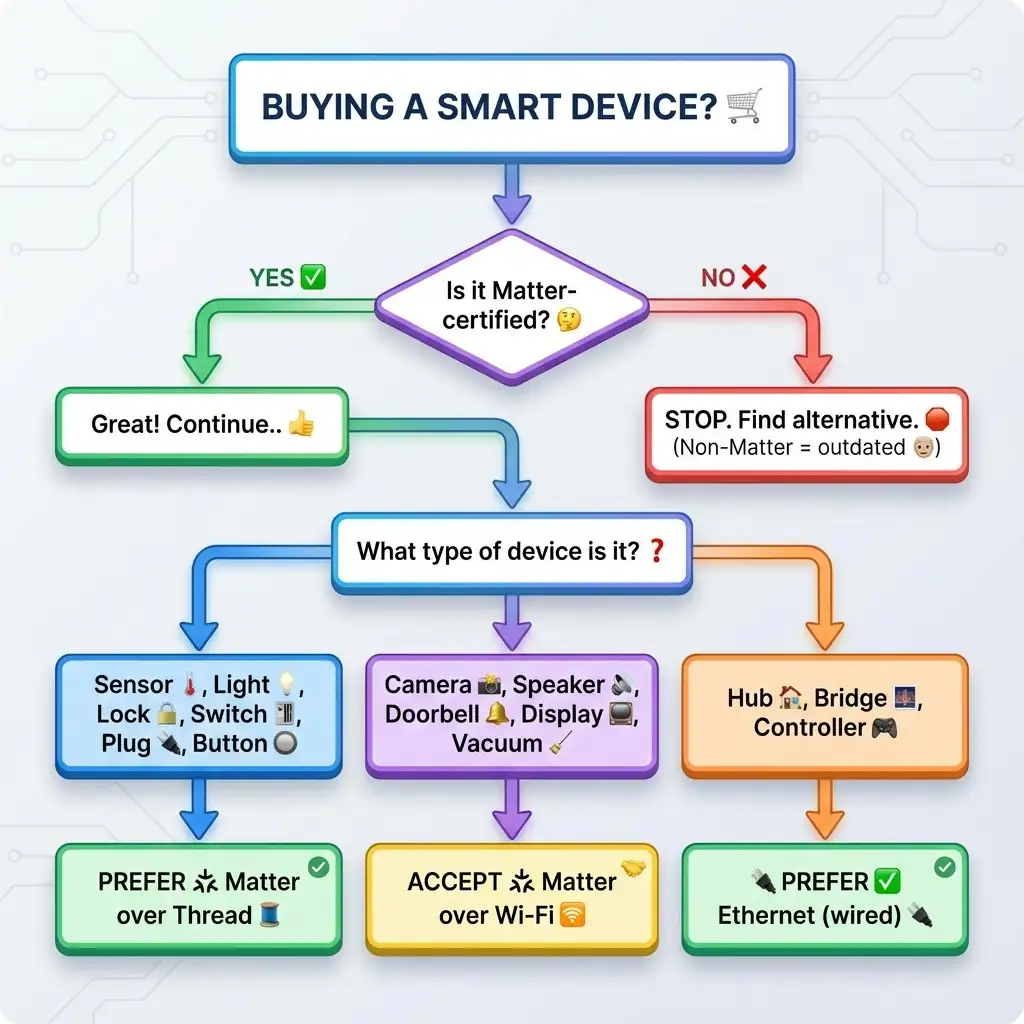
Decision Framework
The Priority Hierarchy
When evaluating any smart home device in 2026:
| Priority | What to Check | Why |
|---|---|---|
| #1 Essential | Matter certification | Universal compatibility, future-proof |
| #2 Preferred | Thread support (for applicable devices) | Speed, battery, reliability |
| #3 Bonus | Brand reputation | Long-term support, updates |
| #4 Nice-to-have | Extra features | Depends on your needs |
Matter vs Thread: 2026 Strengths and Weaknesses
Matter in 2026
| Strengths | Weaknesses |
|---|---|
| ⭐ Universal adoption—nearly every new device | ⚠️ Camera support still maturing |
| ⭐ True multi-platform control is reality | ⚠️ Some advanced features not yet standardized |
| ⭐ Setup dramatically improved since launch | ⚠️ Older pre-Matter devices need bridges |
| ⭐ 8,000+ certified devices available | ⚠️ Some manufacturers slow to update legacy |
| ⭐ Major appliance support arriving | ⚠️ Energy management still emerging |
| ⭐ Consumer awareness is high |
Thread in 2026
| Strengths | Weaknesses |
|---|---|
| ⭐ Mesh networks mature and reliable | ⚠️ Not suitable for high-bandwidth (cameras) |
| ⭐ Border routers in most homes already | ⚠️ Small homes may not see mesh benefits |
| ⭐ Battery life claims proven accurate | ⚠️ Fewer devices than Wi-Fi options |
| ⭐ Response times noticeably faster | ⚠️ Requires at least one border router |
| ⭐ Self-healing works in practice | |
| ⭐ Perfect complement to Matter |
The 2026 Verdict: Which Matters More?
Direct Answer
Matter is more important. Thread makes it better.
Here’s why:
| Factor | Explanation |
|---|---|
| Matter is essential | Without Matter, you’re back to platform lock-in and compatibility chaos |
| Thread is enhancement | Matter works fine over Wi-Fi; Thread makes it work better |
| You can’t skip Matter | Non-Matter devices are already considered legacy/outdated |
| You can skip Thread | Thread-less Matter devices still work (just less efficiently) |
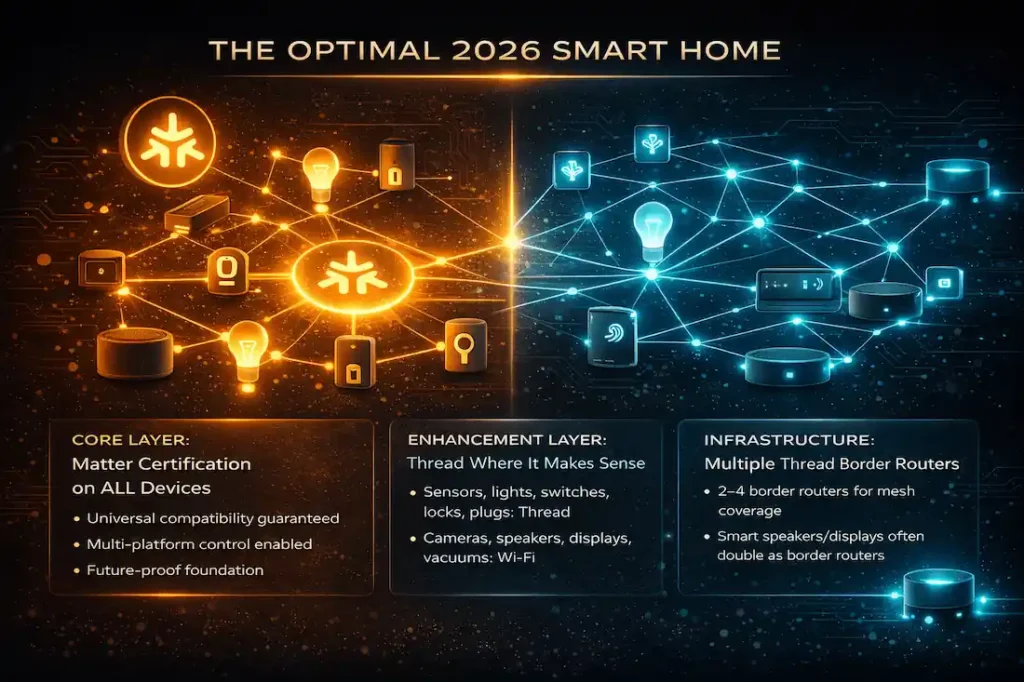
The Ideal 2026 Smart home Setup
What professionals say about Matter vs Thread in 2026 smart homes?
Smart home installers and consultants in 2026 consistently recommend a “Matter-first” approach—ensuring every device carries Matter certification before evaluating Thread support, since Matter guarantees the universal compatibility that prevents ecosystem lock-in and wasted investments. However, for battery-powered devices and anything requiring instant response (sensors, locks, buttons), Thread-enabled options are strongly preferred because the real-world difference in reliability and battery life is immediately noticeable. The most successful smart home deployments in 2026 strategically place Thread-powered devices (switches, plugs) throughout the home to build a strong mesh foundation, then add battery-powered Thread sensors and locks that benefit from that infrastructure.
2026 Quick Reference Card for Matter and thread for smart hoomes
| Question | Answer |
|---|---|
| Which is more important: Matter or Thread? | Matter is essential. Thread is highly recommended enhancement. |
| Can I skip Thread entirely? | Yes, but you’ll miss performance benefits. Sensors/locks especially benefit. |
| Can I skip Matter entirely? | Not recommended. You’ll face compatibility issues and outdated ecosystem. |
| What should I look for first? | Matter certification. Always. |
| Best combination for sensors? | Matter over Thread |
| Best combination for cameras? | Matter over Wi-Fi |
| How many border routers do I need? | 1 for apartments, 2-4 for houses, 4+ for large properties |
| Do I need to buy border routers? | Probably not because smart speakers often include them |
| Are 2026 devices reliable? | Yes. As major improvement from early adoption era |
Frequently Asked Questions (FAQ)
Q: If I had to choose only one, Matter or Thread, which should I pick?
A: Matter, without question. Matter gives you universal compatibility and future-proofing. Thread is an enhancement that makes Matter devices work better, but Matter is the essential foundation.
Q: My home is small (under 1,000 sq ft). Do I really need Thread?
A: Thread still benefits you with faster response and better battery life, but the mesh networking advantage is less critical in small spaces. For tiny apartments, Matter-over-Wi-Fi devices work fine.
Q: Can I mix Matter-over-Thread and Matter-over-Wi-Fi devices?
A: Absolutely. This is the recommended approach. Use Thread for sensors, lights, and locks. Use Wi-Fi for cameras, speakers, and doorbells. They all communicate through Matter regardless of transport.
Q: How do I know if my existing devices support Matter or Thread?
A: Check manufacturer websites for your specific model. Many 2022-2024 devices received Matter support through firmware updates. Thread is usually hardware-dependent and can’t be added via software.
Q: Is Thread replacing Wi-Fi in smart homes?
A: No. Thread complements Wi-Fi—it doesn’t replace it. Thread is optimized for low-power, low-bandwidth devices. Cameras, speakers, and displays will always need Wi-Fi’s bandwidth.
Q: What happens if my Thread border router goes offline?
A: If you have multiple border routers (recommended), the mesh continues working through the others. If you only have one and it goes offline, Thread devices can’t communicate outside the mesh until it returns.
Q: Are 2026 Matter devices more reliable than 2023-2024 versions?
A: Generally yes. The ecosystem has matured significantly. Early Matter devices had teething problems that have largely been resolved through firmware updates and improved manufacturing.
Q: Should I replace my working non-Matter devices with Matter versions?
A: Not urgently. Use them until they fail, then replace with Matter-certified alternatives. The exception: if they’re causing daily frustration, an upgrade may be worthwhile now.
Final Thoughts
The Matter vs Thread question has a simple answer in 2026:
You need Matter. You want Thread.
Matter is the universal foundation that ensures every device works with every platform. Without it, you’re building a fragmented smart home that will frustrate you for years.
Thread is the performance layer that makes your Matter devices work faster, more reliably, with longer battery life. Without it, your smart home works. With it, your smart home excels.
About the Author
Swapnil More is an IT professional and smart home networking enthusiast based in Canada. He focuses on smart home reliability, device security, and network-optimized automation systems through hands-on testing and real-world deployment.